
Hardcore Beast Master Hunter Guide
Viability of Hunters in Hardcore Play
Hunters are a long-distance pet class in World of Warcraft, boasting immense utility, survivability, and damage per second (DPS) due to their independently-scaling pets. Their extensive toolkit offers unparalleled kiting abilities, making them an excellent choice for those new to WoW or hardcore gameplay. Hunters can safely undertake numerous elite quests and eliminate higher-level mobs more effectively than other classes.
Preferred Races for Hunters
Horde Choices
As a Horde hunter, you have three race options: orc, troll, and tauren.
Both orc and troll races have unique advantages. Orcs' +5% pet damage and trolls' +5 bow skill, combined with berserking, are similar in terms of usefulness. The primary weapons for competitive leveling are bows, but enhanced pet damage significantly boosts overall DPS and threat management.
However, Tauren, with their additional health and short-range stun, lag behind in terms of benefits for hunters.
Alliance Choices
Alliance hunters have a choice between dwarves and night elves.
Night elves have superior starting stats and the shadowmeld ability, whereas dwarves have the valuable stoneform ability and a minor gun skill increase.
Shadowmeld allows hunters to avoid unnecessary aggro, especially when combined with feign death, but stoneform's ability to cleanse numerous debuffs could potentially save your life.
For confident players, night elves with their +9 agility are an excellent choice. For those seeking an extra safety net, dwarves' stoneform is recommended.
Essential Terminology
Dazed: A slow debuff applied when hit from behind, or when hunters with the Aspect of the Cheetah active are struck.
Kiting: The tactic of keeping dangerous enemies at a distance, thereby mitigating damage taken.
Melee-weaving: The technique of melee attacking between auto-shots due to separate swing timers for ranged and melee attacks.
Talent Builds Recommendations
Level 10-20
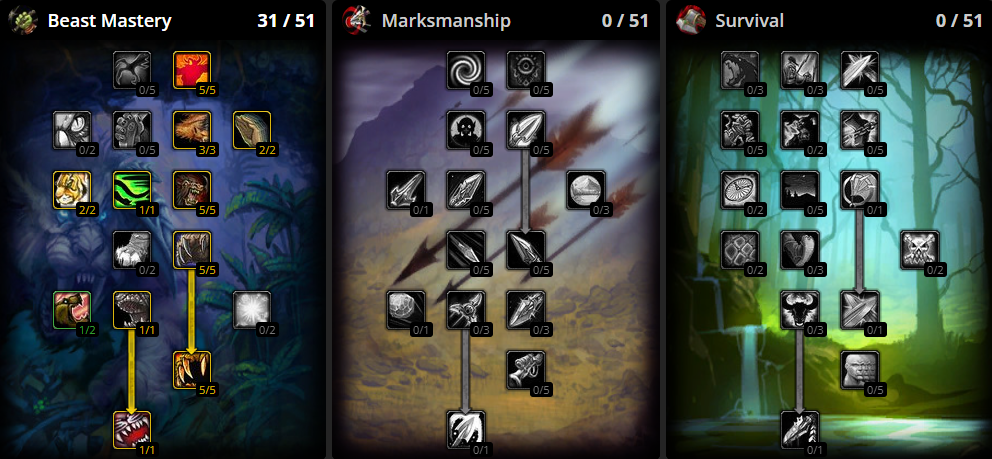
Beast Mastery is the preferred talent tree for initial leveling due to its substantial benefits to the pet's damage, survivability, and utility.
For beginners or average hunters, it's recommended to invest in endurance, thick hide, and improved pet revive. Expert hunters can opt for improved aspect of the hawk, thick hide, and endurance. Beast swiftness is suggested at level 20.
Level 20-40
Continuing to enhance the Beast Mastery tree should be your focus, particularly talents that improve your pet's damage. Some popular utility talents include intimidation, pathfinding, and spirit bond, though the latter could be swapped for improved mend pet for assistance with long-duration debuffs in late game zones.
Level 41-60
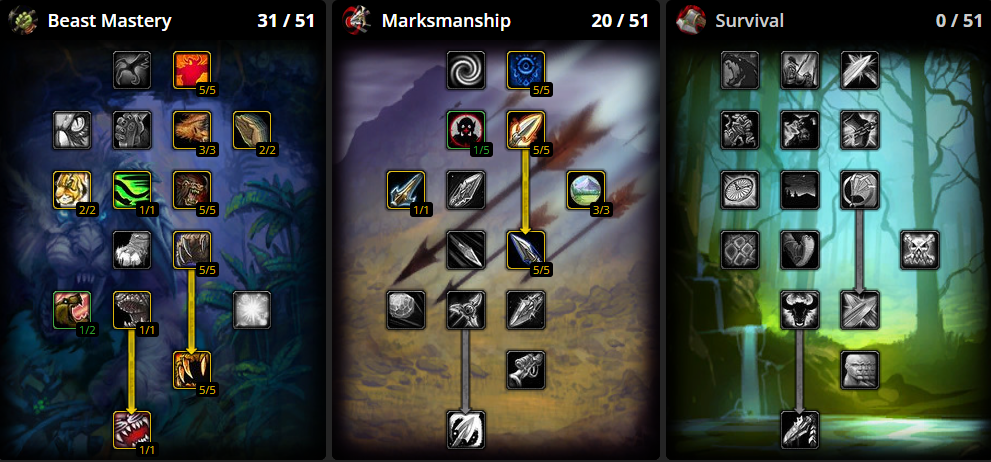
The final 20 points are typically allocated to either the marksmanship or survival trees. The survival tree provides decent DPS talents in the first tier, while the marksmanship tree offers unique talents like hawk eye and aimed shot.
Except for marksmanship's Improved Hunter’s Mark, Improved Arcane Shot, and survival’s Deflection, there are no poor choices for these final points in the first three tiers of both trees.
Kiting Tips for a Hunter in Classic World of Warcraft
Maintain Your Distance: Always keep an eye on the distance between you and your target. Hunters have a minimum range for their bow/gun attacks, so if a mob gets too close, you won't be able to use your primary source of damage.
Aspect of the Cheetah/Pack: This aspect is very useful for kiting as it boosts your speed. However, be careful because getting hit while this aspect is active will cause a daze effect, slowing you down. Turn it off if you expect to get hit.
Use Concussive Shot and Wing Clip: These abilities slow your enemy, giving you more time to put distance between you and them. This is especially effective against melee opponents.
Trap Usage: Frost traps can slow multiple enemies, which is useful when you're dealing with more than one mob. Freeze traps can keep an enemy stationary while you deal with others or create distance.
Feign Death: This ability can help break combat and buy you time to create distance between you and your enemy.
Melee-Weaving Tips for a Hunter in Classic World of Warcraft
Master the Timing: Timing is everything in melee-weaving. Pay attention to your ranged and melee attack timers to maximize your output. Use a timer addon if needed.
Know Your Range: Hunters can deal melee damage up close and ranged damage from afar. Learning the perfect distance to be able to switch between the two can greatly improve your DPS.
Use Raptor Strike: This is your primary melee ability. The idea is to fire an auto-shot, move in to deliver a raptor strike, then back out to resume ranged attacks.
Use Wing Clip: If a mob is too close and your bow/gun attacks are unusable, use Wing Clip to slow the mob down, then back out of melee range and resume your ranged attacks.
Aspect of the Monkey/Hawk Switching: When melee-weaving, you'll be swapping between ranged and melee combat. Use Aspect of the Monkey for increased dodge chance when in melee range, and Aspect of the Hawk when at range for increased ranged attack power.
Pet Management: Your pet can help you with melee-weaving by keeping the aggro of the mobs. Make sure to keep your pet's health up and use its abilities effectively.
Understanding Hunter Traps
Immolation Trap
The Immolation Trap applies a powerful Damage Over Time (DoT) effect to the target. Despite its high mana cost and preparation time, it is particularly effective against formidable enemies due to its substantial damage output over time.
Freezing Trap
The Freezing Trap immobilizes a single enemy that steps on it. A popular strategy when dealing with two enemies is to place a freezing trap, send your pet to attack the first enemy, and use a multi-shot. This technique usually draws the attention of the second mob towards you, making it run into the trap and neutralizing it for the duration of the trap.
Frost Trap
Upon activation, the Frost Trap creates a substantial slow zone for an extended period, making it an excellent choice for planning dangerous escapes or controlling a large group of enemies. When paired with the survival talent Entrapment, it can occasionally immobilize enemies, creating a hazardous area for enemy mobs.
Explosive Trap
The Explosive Trap delivers an initial burst of fire damage to all enemies within its range and subsequently applies a DoT effect, akin to a Mage's Flamestrike spell. This trap serves as one of the few Area of Effect (AoE) abilities at the Hunter's disposal.
Recommended Professions
In the context of hardcore gameplay, the optimal professions for Hunters are Mining and Engineering. Engineering provides substantial utility and AoE damage capabilities, supplementing areas where Hunters are typically lacking. The ability to craft guns and ammo is a minor yet valuable benefit. Alchemy, despite its popularity in hardcore settings, is less beneficial for Hunters.
Pet Management Guide
Pets are powerful allies for Hunters, offering a variety of benefits. The most commonly chosen pets are boars, cats, and owls/bats/carrion birds. Boars offer charge ability and initial threat generation, cats provide high DPS, while owls and carrion birds possess Screech ability, enhancing their survivability and minor AoE threat.
Maintaining Pet Happiness
Feeding your pet is crucial to maintain its happiness, which directly influences its damage output and loyalty points. Higher quality food grants more happiness, so keep the food level within 10 levels of your own. Remember to feed your pet immediately after reviving it to replenish its happiness level.
Choosing the Right Pet
Several factors play into the selection of the right pet, including the pet family, attack speed, and aesthetic appeal. Every pet family has unique stat modifiers, preferred food types, and potential abilities. However, note that the health stat has a more significant impact on pet survivability than armor. Some unique abilities include a boar’s charge, an owl or carrion bird’s screech, a gorilla’s thunderstomp, a scorpid’s scorpid poison, a wind serpent’s lightning breath, and a wolf’s furious howl.
Regarding attack speed, slower attack speeds are generally better before obtaining the Frenzy talent, while faster attack speeds are preferable afterwards. However, this difference is minor and typically does not warrant changing your current pet.
Hunter Stat Priority
Agility: The most important stat for a Hunter, each point gives you ranged attack power and increases your critical hit chance.
Attack Power: Increases the damage done by your abilities and auto-attacks.
Hit Chance: Hit is incredibly important up to the 9% cap (or 6% cap if you have Surefooted talent) to avoid missing your attacks. Once you reach the cap, any additional Hit Rating becomes useless.
Critical Strike Chance: Increases the chance that your attacks will hit for double damage.
Intellect: Increases your total mana, beneficial for longer fights.
Stamina: Increases your total health, useful for surviving longer fights and reducing the chance of sudden death.
Spirit: Increases health and mana regeneration, useful for sustainability, especially during long fights or periods of downtime.
Keep in mind that this priority list can change depending on your current gear, your specific role in a group, and other factors. It's always good to do a bit of research to understand what stats you should be prioritizing in your specific situation.